ViMemory

Hit the limit in Claude. Switch to Opencode without losing context.

Still writing .md files or copy-pasting your chat into the next AI tool?

We believe what should carry over is simple: Your context. Your decisions. Your thread.

The model you use matters less than the memory that follows you into the next one.
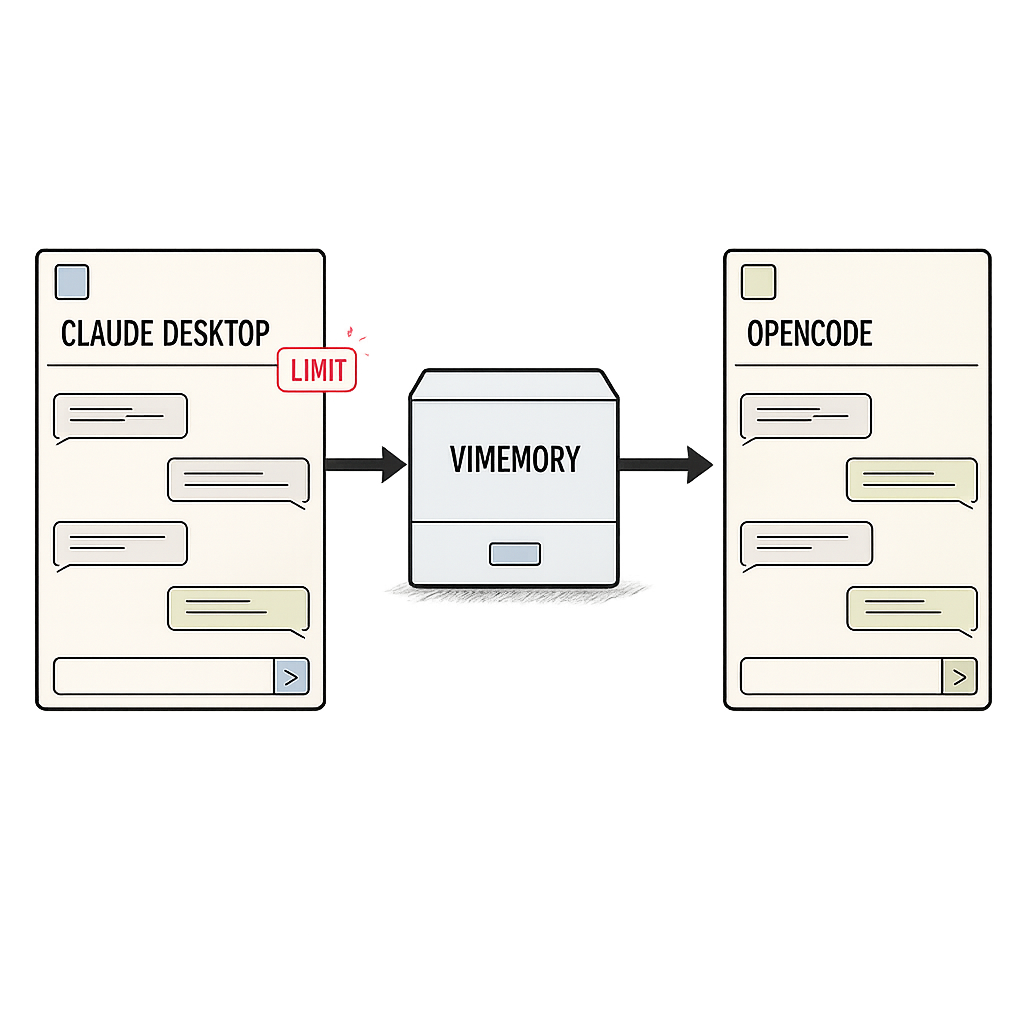
Context flow: hit the limit in Claude Desktop, the thread passes through ViMemory, and continues in opencode.
Hit the limit in Claude. Switch to opencode. ViMemory carries the thread.
01 /

What it actually does

Four things, built to work — not slideware. Read them as a spec sheet of the decisions behind it.

Carries context

Switch models, keep the thread

Save in Claude. Recall in opencode, ChatGPT, DeepSeek, Gemma — whatever you run. No re-pasting, no re-explaining. The limit stops the chat, not the work.

Isolated per person

Your memory is yours

Each teammate gets an isolated namespace. You can't read theirs, they can't read yours. Isolation is enforced, not promised.

Finds by meaning

Ask however you want

"Harga" finds "pricing." It matches on meaning, not exact words — so recall works even when you phrase it differently.

Your infrastructure

Nothing leaves your server

Self-hosted on your own box. No third party holds your team's memory. You keep the keys, literally.

02 /

How it works

ViMemory
"save this to vimemory mcp"
Saved — "Architecture: FastAPI gateway, self-hosted on your own server."
1

Save from your chat

Tell your AI: "save this to vimemory mcp." It summarizes and stores it. One line, done.

Switch model
Clauderate limited
Opencode + DeepSeek Flashswitch →
MiniMax M2.7
ChatGPT
2

Hit a limit, switch interface and AI models

Out of Claude credits? Move to Opencode or other interface. Bring your memory there.

Recall
Pricing set at $8/mo — decided 3 days ago
Team size capped at 24 users
Monthly billing, no trial period
3

Recall and continue

Ask the new model. It pulls the relevant context by meaning and picks up where you stopped.

↳ See it work

49 seconds, no narration.

Save in Claude → hit the limit → recall in opencode. Same thread, different model.
03 /

Under the hood

No black box. Here's exactly what runs and why each piece is there. If a term's new to you, the plain-English bit after it is the part that matters.
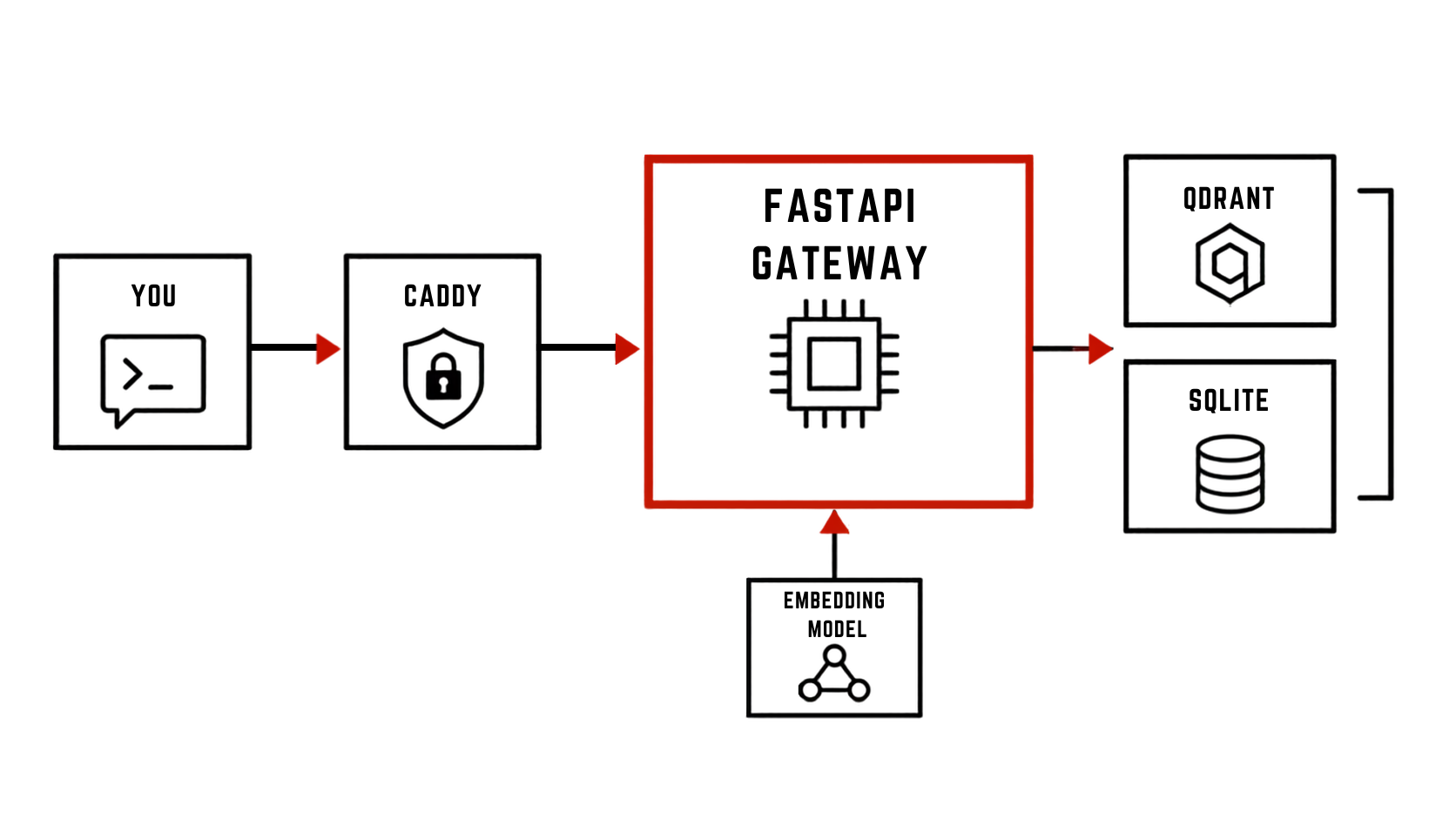
Architecture: you send a request through Caddy (HTTPS front door) to the FastAPI Gateway, which uses an Embedding model and stores data in Qdrant and SQLite.
You → Caddy → Gateway → Qdrant + SQLite. The embedding model feeds the Gateway. One key, one namespace.

Every box, in plain English ↓

FastAPI GatewayThe brain
The one service everything talks to. It takes your text, decides what to do with it, and enforces that your API key only ever touches your own memory. Written in Python. Built it ourselves — it's the part that's actually "ViMemory."
Embedding modelTurns words into math
A small model (all-MiniLM) that converts text into a list of numbers. Text with similar meaning gets similar numbers — that's how "harga" can find "pricing." Runs locally on your server, so it's free and nothing gets sent out to an API.
QdrantSearch by meaning
A vector database. It stores those number-lists and, when you ask something, finds the closest matches by meaning instead of exact keywords. This is the engine behind "recall the right context."
SQLiteThe record book
A plain, file-based database holding the source of truth: who saved what, when, the original text, the tags, and the hashed API keys. Boring on purpose. Boring is reliable.
CaddyThe locked front door
A reverse proxy that puts automatic HTTPS in front of everything. It's the only piece exposed to the internet — Qdrant and the database sit behind it, unreachable from outside.
DockerThe shipping box
All of the above run as containers started by one command. That's how a non-developer can stand the whole thing up on a server without wiring each piece by hand.
No black box

The whole thing is open. Feel it on our key, then own it on yours.

Nothing here is a mockup. The gateway, the connector, the docs — all open, all yours to run. Start on a trial key in minutes, and when you outgrow it, stand up your own server and keep your team's memory entirely on your box.

04 /

Who it's for

Right for you if…

  • Your team runs Claude alongside other models
  • You keep hitting limits mid-work
  • You're tired of re-pasting the same context
  • You want your data on your own server
  • You can tolerate a beta to get in early

Skip it if…

  • You want old chat history auto-imported
  • You won't or can't run a small server
  • You need a polished, finished product now
  • You're a solo user on one model only
  • You expect memory to make models smarter
05 / Get the build

Drop your email. Get everything to run it.

No price, no card. It's a beta — early teams get in free. One email and we send you the whole package: a key on our gateway so you can feel it in minutes, plus the code and docs to own it yourself whenever you're ready.

Honest
  • No old-chat import. Memory starts empty and fills from the day you start saving.
  • It's a beta. Small team, rough edges, things change.
  • It won't make a weak model smart. Memory carries context, not brains.

What lands in your inbox

  • Your secret keyA personal msk_ key — your own isolated memory, capped at a few saves so you can feel it without setup.
  • The endpoint URLPoint Claude or any model at our gateway and start saving + recalling immediately.
  • Non-tech install docsA plain-English guide that uses Claude or OpenAI to walk you through setup — no terminal skills assumed. Preview it →
  • The GitHub reposThe gateway and the local connector — the full, open build. Run your own server when you outgrow the trial.

We'll send a one-click confirm first — that's how we keep dummy and throwaway emails out. Click it, and the package arrives.

We onboard a few teams at a time, personally. Real email gets a real key. No spam, unsubscribe anytime.